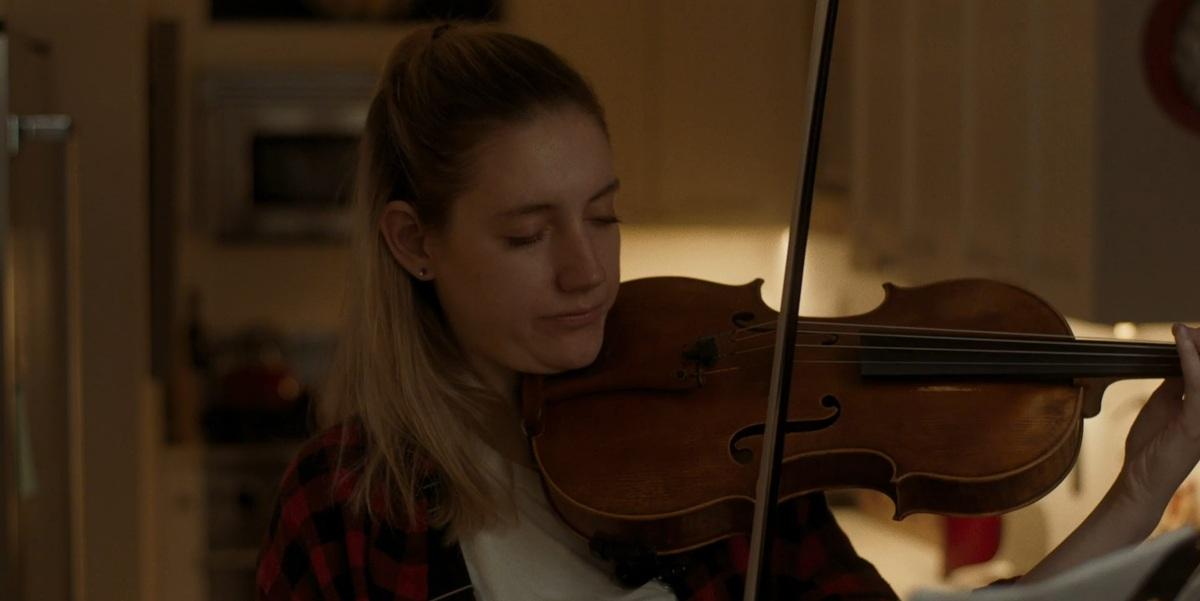
What happens when you’ve spent most of your life mastering something that nobody particularly wants to pay you for? In On a String, Isabel Hagen plays a Juilliard-trained violist whose professional life consists of weddings, private parties, and assorted musical engagements that place her in the background of other people’s more consequential moments. Her education is prestigious, her talent undeniable, and her career going precisely nowhere. It’s a rather unpromising premise for a comedy, which is exactly why it works.
Hagen, a classically trained violist who subsequently established herself as a stand-up comedian, writes, directs, and stars in this wonderfully peculiar debut feature. Her fictional counterpart, also named Isabel, lives with her parents in New York City, performs with a string quartet, and navigates a professional environment in which artistic accomplishment and financial security appear to have very little to do with each other. There are auditions to prepare for, students to teach, and relationships to mismanage, but little resembling a conventional career trajectory.
The film opens with a marriage proposal in a park, accompanied by Isabel playing Chopin. The woman rejects the proposal, leaving the musician awkwardly continuing her performance while the couple’s romantic expectations collapse in front of her. It’s a neat introduction to the film’s particular comic sensibility: the absurdity is not in the situation itself, but in the social obligation to behave as though nothing unusual has happened.
Much of On a String unfolds through similarly uncomfortable encounters. Isabel and her fellow musicians, including her friend Christina (Ling Ling Huang), drift between private events and miscellaneous paid engagements, observing the intimate lives of people who barely acknowledge their presence. The arrangement creates an amusing reversal of the conventional artist-audience relationship. These are highly trained performers, yet their principal professional responsibility is to remain unobtrusive.
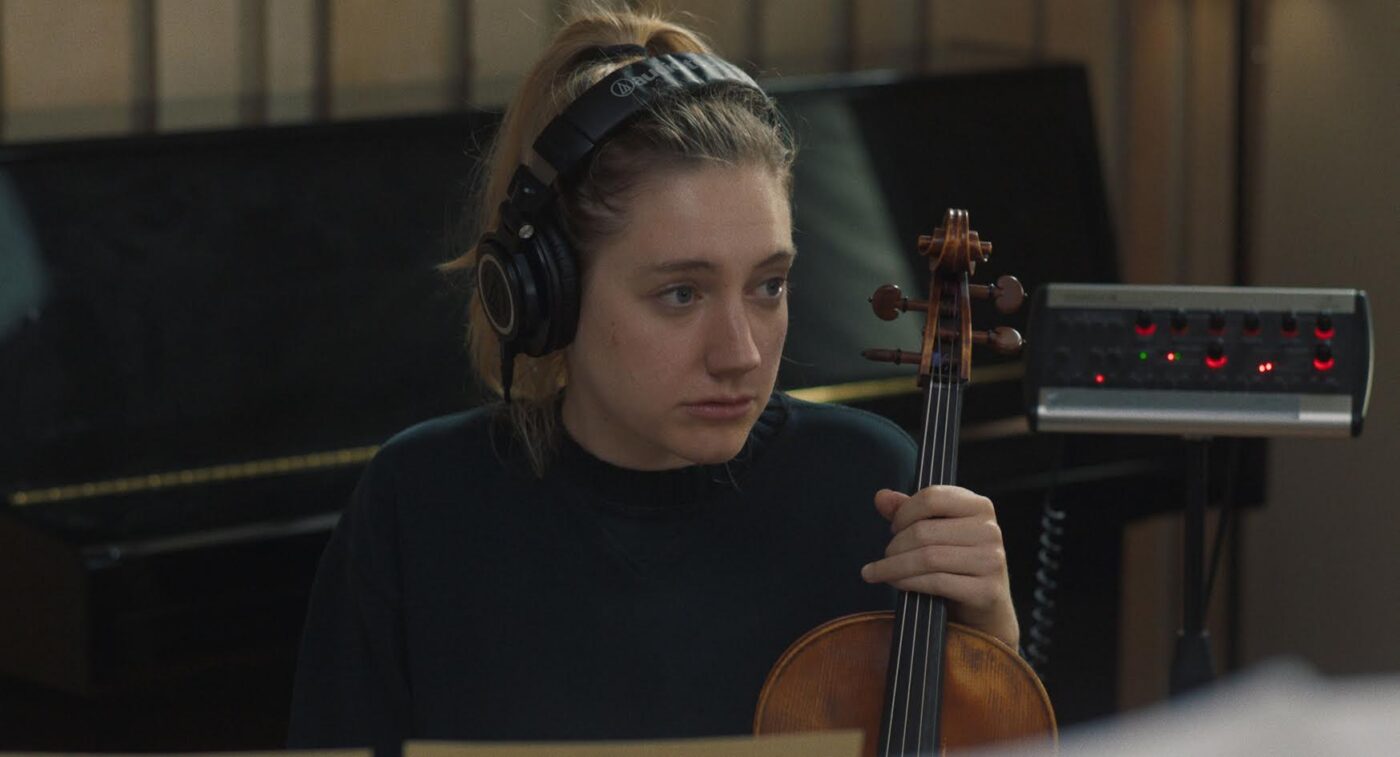
There is something quietly brutal about the social hierarchy this reveals. Classical musicians spend years developing skills that demand extraordinary discipline, only to find themselves providing decorative background noise at events where the guests are considerably more interested in one another than in the music. Hagen understands this world from personal experience, having performed with Broadway orchestras and musicians including Björk, Steve Reich, and Vampire Weekend. Her portrayal of its indignities feels less like an outsider’s satire than an insider’s account of an industry whose prestige rarely translates into financial reward.
When an ex-boyfriend, now a cellist with the New York Philharmonic, mentions an opening for a violist, Isabel briefly acquires something resembling a professional objective. An audition for one of the country’s most prestigious orchestras might offer an escape from the precarious existence of freelance performance. Yet the prospect of success seems to generate as much anxiety as enthusiasm, and her preparation becomes entangled with personal distractions, emotional uncertainty, and a conspicuous lack of momentum.
Hagen resists the familiar cinematic convention in which artistic ambition is eventually rewarded through perseverance and a suitably dramatic breakthrough. Isabel is talented but inconsistent, intelligent but frequently indecisive, and not especially good at recognizing when she is making her own circumstances worse. Her reluctance to pursue success with the intensity expected of a serious artist is part of what makes her interesting. The film allows her to be both sympathetic and occasionally exasperating, without insisting that these qualities need to be reconciled.
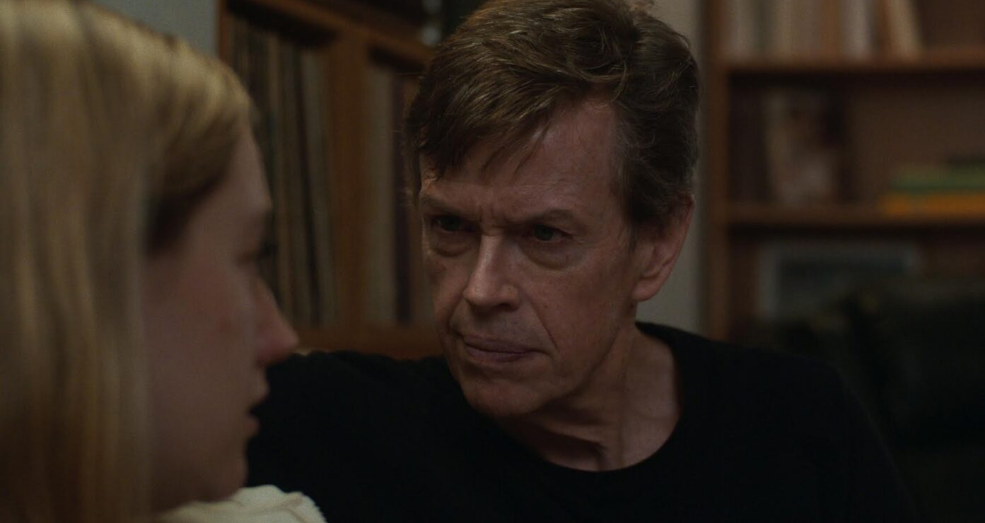
Her family provides another source of precisely calibrated discomfort. Dylan Baker plays her father, whose responses to Isabel’s insecurities are often devastatingly practical. When she asks her parents to believe in her, he wants to know exactly what that would involve. It’s an excellent joke, but also a rather accurate description of the difficulty of supporting someone whose ambitions remain frustratingly undefined.
The supporting characters are similarly unwilling to provide Isabel with much reassurance. Frederick Weller plays the married father of one of her students, whose interest in her introduces a distinctly questionable romantic possibility, while Eric Bogosian appears as a demanding independent filmmaker. These encounters give Hagen opportunities to explore the subtle power imbalances that structure freelance creative work, where professional opportunities, personal boundaries, and the need to remain agreeable frequently become entangled.
What makes the comedy effective is Hagen’s refusal to inflate these disappointments into major emotional events. The humor emerges from conversational timing, awkward silences, and the small humiliations that accumulate when people are obliged to remain polite. Editor Olivia Vessel gives the exchanges a clipped rhythm, occasionally allowing an uncomfortable moment to linger just long enough for its absurdity to become apparent. The film’s 78-minute running time also works in its favor. Rather than forcing Isabel’s loosely connected experiences into an elaborate narrative, Hagen lets them accumulate into a portrait of a particular social and professional existence.
There are recognizable traces of Noah Baumbach’s Frances Ha and the self-exposing comedy of Lena Dunham’s Girls, particularly in the portrayal of an educated New Yorker whose professional and romantic life has failed to develop according to plan. But Hagen’s sensibility is more restrained, and her protagonist is less interested in turning every personal disappointment into a defining event. Where similar films often treat artistic uncertainty as a temporary stage before self-discovery, On a String is more willing to consider the possibility that uncertainty might simply be part of adulthood.
The film’s relationship with classical music is equally refreshing. Rather than presenting musicians as tortured geniuses or exceptional individuals destined for greatness, Hagen depicts them as workers negotiating an unstable labor market. The performances themselves are treated seriously, with trained musicians playing live on camera, but the surrounding circumstances are frequently ridiculous. The contrast makes a broader point about the contemporary creative economy, where cultural prestige and economic value are distributed according to very different principles.
Hagen’s screenplay won Best Screenplay in the U.S. Narrative Competition at the 2025 Tribeca Festival, an appropriate recognition for a film whose strengths lie in its dialogue and precise understanding of social behavior. Yet the achievement is also slightly ironic. A filmmaker who spent years navigating the uncertainties of a creative profession has made a critically recognized comedy about the uncertainties of another. In her own account of the production, Hagen describes a process stretching from an almost nonexistent-budget web series to years of writing, fundraising, and eventually shooting the feature in 2023. The film’s existence is itself an example of the persistence its protagonist struggles to summon.
Not everything about On a String is equally convincing. Its episodic structure occasionally makes Isabel’s relationships feel underdeveloped, while her passivity can become frustrating when the film appears reluctant to push her toward any meaningful decision. But these limitations are also connected to its distinctive perspective. Hagen is not particularly interested in the transformative power of ambition, and she avoids imposing a tidy narrative of professional or personal growth on a character who seems fundamentally unsure whether she wants either.
In a culture increasingly preoccupied with productivity, self-improvement, and the expectation that every talent should become a successful career, there is something appealingly subversive about this refusal. Isabel has spent years acquiring an extraordinary skill, yet she remains uncertain about what she wants from it. The film neither condemns her lack of direction nor romanticizes it. Instead, it allows her to inhabit the uncomfortable space between being good at something and knowing what to do with it.
Perhaps the most interesting thing about On a String is that its protagonist is not really searching for success, at least not in the conventional sense. She wants connection, reassurance, and some indication that the life she has constructed makes sense. The problem is that none of these things can be secured through an audition, a prestigious degree, or another paid engagement.
Hagen has made a comedy about the peculiar indignity of being highly qualified for a life that refuses to organize itself around your qualifications. It’s a small, sharply written film, and one that understands how absurd the pursuit of artistic success can become when the art itself is no longer the problem.
On a String, written, directed by, and starring Isabel Hagen. 78 minutes. Premiered at Tribeca in 2025; released in select U.S. theaters September 11, 2026.