
What happens when doing everything right is no longer enough to get ahead? In James Gray’s Paper Tiger, the answer involves organized crime, a polluted Brooklyn canal, and a family whose modest aspirations become entangled in something considerably more sinister. Set in 1986, the film returns to a period when American prosperity was increasingly measured through individual success, while the economic and moral structures supporting that success were beginning to fracture. Forty years later, the circumstances have changed, but the underlying anxieties feel remarkably familiar.
Gray has spent much of his career exploring the uncomfortable relationship between personal ambition and the social circumstances that shape it. From the immigrant experience in The Immigrant (2013) to the class and racial tensions of Armageddon Time (2022), his films tend to focus on characters whose desires are perfectly understandable, even when their decisions are not. In Paper Tiger, starring Adam Driver, Miles Teller, and Scarlett Johansson, he returns to the outer boroughs of New York, a setting that has become almost inseparable from his cinematic identity.
The story follows Irwin Pearl (Teller), an engineer living in Queens with his wife Hester (Johansson) and their two sons. Their ambitions are recognizably middle-class: financial stability, good schools, and the possibility of providing their children with opportunities they never had themselves. When Irwin’s older brother Gary (Driver), a charismatic former police officer turned security consultant, introduces him to a potentially lucrative business opportunity involving the redevelopment of industrial land along Brooklyn’s Gowanus Canal, the proposition seems to offer precisely the financial breakthrough the family needs.
The arrangement, however, involves Russian organized crime, and what begins as an opportunity to improve the family’s circumstances gradually exposes them to a world in which conventional ideas of honesty, loyalty, and professional responsibility have little authority.
What makes the premise interesting is that Irwin is not particularly greedy. He is neither a criminal mastermind nor a frustrated outsider desperate to prove himself. His aspirations are ordinary, even conservative. He wants to provide for his family and believes that hard work should make this possible. His vulnerability lies in the assumption that the economic system rewards people who play by its rules.
Gray seems particularly interested in what happens when this assumption encounters a reality governed by entirely different principles.
The film’s historical setting is significant. Reagan-era America celebrated entrepreneurship, deregulation, and individual wealth as evidence of national renewal. Financial success increasingly became a measure not only of achievement but of personal worth. Against this background, Gary’s extravagant confidence and entrepreneurial instincts appear almost emblematic of the decade. He understands that opportunities are often created through connections, persuasion, and a willingness to operate in morally ambiguous territory.
Driver gives Gary a flamboyant energy that contrasts with his brother’s restraint. Arriving at the family home with expensive steaks and an almost theatrical display of generosity, he embodies a particular kind of American masculinity: charismatic, financially ambitious, and convinced that confidence can overcome almost any obstacle. His performance makes Gary both appealing and deeply unsettling, a man whose genuine affection for his family exists alongside an increasingly dangerous capacity for self-deception.
Johansson’s Hester, meanwhile, complicates the familiar dynamic of the supportive wife watching her husband make disastrous decisions. She has her own anxieties and ambitions, and the family’s apparent stability depends partly on the emotional and practical labor she performs. Her private struggle with a health crisis introduces another dimension to the film’s examination of vulnerability, suggesting that the threats facing the family are not confined to criminal violence or financial ruin.

The choice of the Gowanus Canal as the setting for the brothers’ business venture is especially revealing. For much of the twentieth century, the waterway served as an industrial artery, accumulating the chemical waste and environmental damage associated with New York’s economic expansion. In Paper Tiger, the canal becomes a physical manifestation of the costs that prosperity leaves behind. Its polluted waters are not simply an atmospheric backdrop but a reminder that wealth is often produced through processes whose consequences remain conveniently out of sight.
There is a contemporary resonance here that extends beyond the film’s period setting. From speculative real estate development to financial engineering and the increasingly opaque structures of global investment, the distinction between legitimate enterprise and exploitation can become difficult to locate. The language of opportunity frequently obscures the mechanisms through which wealth is accumulated, while those who benefit from the system are rarely the ones required to absorb its consequences.
Yet Gray avoids turning these observations into an explicit political argument. His interest remains with the people caught inside these structures, particularly their capacity to rationalize decisions that they might otherwise recognize as dangerous.
This is also what distinguishes his approach from the conventional American crime thriller. In films such as Goodfellas or Scarface, criminal ambition often comes with a seductive mythology of power, excess, and spectacular downfall. Gray’s characters operate at a considerably less glamorous level. They are not trying to conquer an empire. They want to pay their bills, send their children to college, and perhaps move into a slightly more comfortable version of the lives they already have.
The resulting tragedy feels less like punishment for extraordinary ambition than the consequence of ordinary people encountering a system they fundamentally misunderstand.
Stylistically, Gray approaches the material with a classical sensibility that has become increasingly unusual in contemporary American cinema. Working with cinematographer Joaquín Baca-Asay, he favors carefully constructed compositions, patient storytelling, and an attention to physical environments that allows tension to develop without constant visual stimulation. His filmmaking owes more to the morally complicated American dramas of the 1970s than to the accelerated editing and narrative efficiency of contemporary streaming entertainment.
This commitment to an older cinematic language is not without its limitations. The film’s deliberate pacing and heightened emotional register occasionally threaten to make its characters feel like figures in a predetermined tragedy. Gray’s tendency toward operatic seriousness can also leave relatively little room for ambiguity in the emotional atmosphere, even when the characters themselves remain morally complicated.
Nevertheless, there is something compelling about his refusal to make these stories more immediately accessible or reassuring. His films are rarely concerned with providing satisfying resolutions, and Paper Tiger appears particularly uninterested in the idea that suffering necessarily produces wisdom.
The film also raises a broader question about the place of directors like Gray in contemporary Hollywood. Despite a career spanning more than three decades, collaborations with some of the industry’s most recognizable actors, and considerable critical admiration, he remains an unusual figure: an American filmmaker whose work is frequently celebrated but seldom commercially dominant. As David Sims recently observed in The Atlantic, Gray’s films occupy an awkward position within an industry increasingly organized around recognizable intellectual property, franchise potential, and easily marketable concepts. Perhaps that position is appropriate for a director so preoccupied with people who never quite fit into the systems surrounding them.
What ultimately makes Paper Tiger relevant is not its depiction of organized crime or even its critique of Reagan-era capitalism. It is the uncomfortable possibility that the Pearls’ predicament is not especially exceptional. Their belief in professional advancement, family stability, and the moral legitimacy of economic ambition remains central to contemporary American life, even as the conditions required to achieve those things become increasingly uncertain.
Gray’s film suggests that the danger lies not simply in pursuing prosperity, but in assuming that prosperity and virtue are naturally connected. Irwin’s tragedy emerges from his inability to recognize how easily the promise of a better life can become an instrument of manipulation.
There is no particular comfort in this observation, and Gray offers little reason to expect one. In Paper Tiger, the American dream is not exposed as an outright fraud. It is something perhaps more troubling: a promise that remains persuasive even when the system delivering it has stopped functioning as advertised.
And that may explain why a film set in 1986 feels so current. The clothes, cars, and criminal networks belong to another era. The conviction that one more opportunity might finally make everything work out does not.
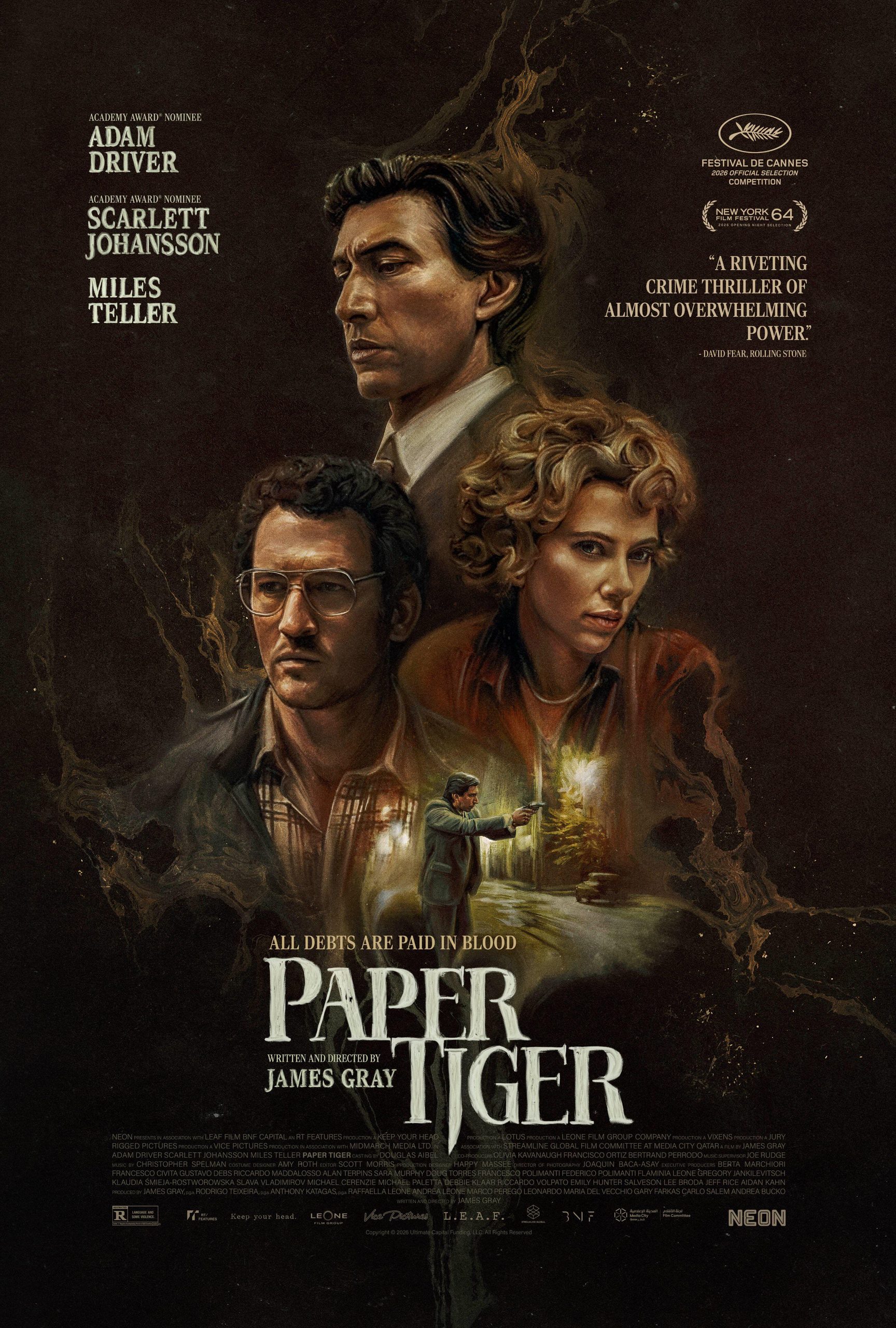
Paper Tiger (2026), written and directed by James Gray. Starring Adam Driver, Miles Teller, and Scarlett Johansson. Distributed by Neon. Limited theatrical release begins November 13, 2026.